Monday, October 02, 2006

The Pope's words - II

Socrates or Muhammad?
Joseph Ratzinger on the destiny of reason.
by Lee Harris

To the memory of Oriana Fallaci
On September 12, Pope Benedict XVI delivered an astonishing speech at the Uni versity of Regensburg. Entitled "Faith, Reason, and the University," it has been widely discussed, but far less widely understood. The New York Times, for example, headlined its article on the Regensburg address, "The Pope Assails Secularism, with a Note on Jihad." The word "secularism" does not appear in the speech, nor does the pope assail or attack modernity or the Enlightenment. He states quite clearly that he is attempting "a critique of modern reason from within," and he notes that this project "has nothing to do with putting the clock back to the time before the Enlightenment and rejecting the insights of the modern age. The positive aspects of modernity are to be acknowledged unreservedly."

Benedict, in short, is not issuing a contemporary Syllabus of Errors. Instead, he is asking those in the West who "share the responsi bility for the right use of reason" to return to the kind of self-critical examination of their own beliefs that was the hallmark of ancient Greek thought at its best. The spirit that animates Benedict's address is not the spirit of Pius IX; it is the spirit of Socrates. Benedict is inviting all of us to ask ourselves, Do we really know what we are talking about when we talk about faith, reason, God, and community?

For many, it will seem paradoxical that the Roman pontiff has invoked the critical spirit of Socrates. The pope, after all, is the embodiment of the traditional authority of the Church, and the Church is supposed to have all the answers. Yet Socrates was famous as the man who had all the questions. Far from making any claims to infallibility, Socrates argued that the unexamined life was not worth living, and he was prepared to die rather than cease the process of critical self-examination. Socrates even refused to call himself wise, arguing instead that he only deserved to be called a "lover of wisdom."

Socrates skillfully employed paradox as a way to get people to think, yet even he might have been puzzled by the paradox of a Roman Catholic pope who is asking for a return to Socratic doubt and self-critique. Benedict must be perfectly aware of this paradox himself, so that we must assume that he, too, is using paradox deliber ately, as Socrates did, and for the same reason: to startle his listeners into rethinking what they thought they already knew.

But why should Pope Benedict XVI feel the need at this moment in history to emphasize and highlight the role that Greek philosophical inquiry played in "the foundation of what can rightly be called Europe"? Christian Europe, after all, was a fusion of diverse elements: the Hebrew tradition, the experience of the early Christian community, the Roman genius for law, order, and hierarchy, the Germanic barbarians' love of freedom, among many others. In this cultural amalgam, Greek philosophy certainly played a role, yet its contribution was controversial from the beginning. In the second century A.D., the eminent Christian theologian Tertullian, who had been trained as a Roman lawyer, asked contemptuously: "What does Athens have to do with Jerusalem?" For Tertullian, Athens represented hot-air and wild speculation. Many others in the early Church agreed, among them those who burned the writings of the most brilliant of all Greek theologians, Origen. Yet Benedict's address can be understood as a return to the position of the man who taught Origen, the vastly erudite St. Clement of Alexandria.

St. Clement argued that Greek philosophy had been given by God to mankind as a second source of truth, comparable to the Hebrew revelation. For St. Clement, Socrates and Plato were not pagan thinkers; they prefigured Christianity. Contrary to what Tertullian believed, Christianity needed more than just Jerusalem: It needed Athens too. Pope Benedict in his address makes a strikingly similar claim: "The encounter between the Biblical message and Greek thought did not happen by chance." This encounter, for Benedict, was providential, just as it had been for St. Clement. Furthermore, Benedict argues that the "inner rapprochement between Biblical faith and Greek philosophical inquiry was an event of decisive importance not only from the standpoint of the history of religions, but also from that of world history." For Benedict, however, this event is not mere ancient history. It is a legacy that we in the West are all duty-bound to keep alive--yet it is a legacy that is under attack, both from those who do not share it, namely Islam, and from those who are its beneficiaries and do not understand it, namely, Western intellectuals.

Let us begin by taking seriously Benedict's claim that in his address he is attempting to sketch, in a rough outline, "a critique of modern reason from within." He is not using his authority as the Roman pontiff to attack modern reason from the point of view of the Church. His approach is not dogmatic; it is dialectical. He stands before his learned audience not as the pope, but simply as Joseph Ratzinger, an intelligent and thoughtful man, who makes no claims to any privileged cognitive authority. He has come, like Socrates, not to preach or sermonize, but to challenge with questions.

Ratzinger is troubled that most educated people today appear to think that they know what they are talking about, even when they are talking about very difficult things, like reason and faith. Reason, they think, is modern reason. But, as Ratzinger notes, modern reason is a far more limited and narrow concept than the Greek notion of reason. The Greeks felt that they could reason about anything and everything--about the immortality of the soul, metempsychosis, the nature of God, the role of reason in the universe, and so on. Modern reason, from the time of Kant, has repudiated this kind of wild speculative reason. For modern reason, there is no point in even asking such questions, because there is no way of answering them scientifically. Modern reason, after Kant, became identified with what modern science does. Modern science uses mathematics and the empirical method to discover truths about which we can all be certain: Such truths are called scientific truths. It is the business of modern reason to severely limit its activity to the discovery of such truths, and to refrain from pure speculation.

Ratzinger, it must be stressed, has no trouble with the truths revealed by modern science. He welcomes them. He has no argument with Darwin or Einstein or Heisenberg. What disturbs him is the assumption that scientific reason is the only form of reason, and that whatever is not scientifically provable lies outside the universe of reason. According to Ratzinger, the results of this "modern self-limitation of reason" are twofold. First, "the human sciences, such as history, psychology, sociology, and philosophy, attempt to conform themselves to this canon of scientificity." Second, "by its very nature [the scientific] method excludes the question of God, making it appear an unscientific or pre-scientific question."

In making this last point about God, it may appear that Joseph Ratzinger, the critical thinker, has switched back into being Pope Benedict XVI, the upholder of Christian orthodoxy. Defenders of modern reason and modern science can simply shrug off his objection to their exclusion of God by saying, "Of course, the question of God cannot be answered by science. This was the whole point of Kant's Critique of Pure Reason. Science can neither prove, nor disprove God's existence. Furthermore, by bringing in the question of God, you have violated your own ground rules. You claimed to be offering a critique of modern reason from within, but by dragging God into the discussion, you are criticizing modern reason from the standpoint of a committed Christian. You are merely saying that modern reason excludes God; we who subscribe to the concept of modern reason are perfectly aware of this fact. Maybe it troubles you, as a Christian, but it doesn't bother us in the least."

Can Joseph Ratzinger, the critical thinker, answer this objection? Yes, he can, and he does. His answer is provided by his discussion of jihad. Contrary to what the New York Times reported, Ratzinger is not providing merely "a note on jihad" that has no real bearing on the central message of his address. According to his own words, the topic of jihad constitutes "the starting-point" for his reflection on faith and reason. Ratzinger uses the Islamic concept of jihad to elucidate his critique of modern reason from within.

Modern reason argues that questions of ethics, of religion, and of God are outside its compass. Because there is no scientific method by which such questions can be answered, modern reason cannot concern itself with them, nor should it try to. From the point of view of modern reason, all religious faiths are equally irrational, all systems of ethics equally unverifiable, all concepts of God equally beyond rational criticism. But if this is the case, then what can modern reason say when it is confronted by a God who commands that his followers should use violence and even the threat of death in order to convert unbelievers?

If modern reason cannot concern itself with the question of God, then it cannot argue that a God who commands jihad is better or worse than a God who commands us not to use violence to impose our religious views on others. To the modern atheist, both Gods are equally figments of the imagination, in which case it would be ludicrous to discuss their relative merits. The proponent of modern reason, therefore, could not possibly think of participating in a dialogue on whether Christianity or Islam is the more reasonable religion, since, for him, the very notion of a "reasonable religion" is a contradiction in terms.

Ratzinger wishes to challenge this notion, not from the point of view of a committed Christian, but from the point of view of modern reason itself. He does this by calling his educated listeners' attention to a "dialogue--carried on--perhaps in 1391 in the winter barracks near Ankara--by the erudite Byzantine emperor Manuel II Paleologus and an educated Persian on the subject of Christianity and Islam, and the truth of both." In particular, Ratzinger focuses on a passage in the dialogue where the emperor "addresses his interlocutor with a startling brusqueness" on the "central question about the relationship between religion and violence in general, saying: 'Show me just what Mohammed brought that was new, and there you will find things only evil and inhuman, such as his command to spread by the sword the faith he preached.'"

Ratzinger's daring use of this provocative quotation was not designed to inflame Muslims. He was using the emperor's question in order to offer a profound challenge to modern reason from within. Can modern reason really stand on the sidelines of a clash between a religion that commands jihad and a religion that forbids violent conversion? Can a committed atheist avoid taking the side of Manuel II Paleologus when he says: "God is not pleased by blood--and not acting reasonably is contrary to God's nature. . . . Whoever would lead someone to faith needs the ability to speak well and to reason properly, without violence and threats. . . . To convince a reasonable soul, one does not need a strong arm, or weapons of any kind, or any other means of threatening a person with death."

Modern science cannot tell us that the emperor is right in his controversy with the learned Persian over what is or is not contrary to God's nature. Modern reason proclaims such questions unanswerable by science--and it is right to do so. But can modern reason hope to survive as reason at all if it insists on reducing the domain of reasonable inquiry to the sphere of scientific inquiry? If modern reason cannot take the side of the emperor in this debate, if it cannot see that his religion is more reasonable than the religion of those who preach and practice jihad, if it cannot condemn as unreasonable a religion that forces atheists and unbelievers to make a choice between their intellectual integrity and death, then modern reason may be modern, but it has ceased to be reason.

The typical solution to the problem of ethics and religion offered by modern reason is quite simple: Let the individual decide such matters himself, by whatever means he wishes. If a person prefers Islam over Christianity, or Jainism over Methodism, that is entirely up to him. All such choices, from the perspective of modern reason, are equally leaps of faith, or simply matters of taste; hence all are equally irrational. Ratzinger recognizes this supposed solution, but he sees the fatal weakness in it. Modern reason asserts that questions of ethics and religion

have no place within the purview of collective reason as defined by "science," . . . and must thus be relegated to the realm of the subjective. The subject then decides, on the basis of his experiences, what he considers tenable in matters of religion, and the subjective "conscience" becomes the sole arbiter of what is ethical. In this way, though, ethics and religion lose their power to create a community and become a completely personal matter. This is a dangerous state of affairs for humanity, as we see from the disturbing pathologies of religion and reason which necessarily erupt when reason is so reduced that questions of religion and ethics no longer concern it.

If the individual is free to choose between violence and reason, it will become impossible to create a community in which all the members restrict themselves to using reason alone to obtain their objectives. If it is left up to the individual to use violence or reason, then those whose subjective choice is for violence will inevitably destroy the community of those whose subjective choice is for reason. Worse still, those whose subjective choice is for violence do not need to constitute more than a small percentage of the community in order to destroy the very possibility of a community of reasonable men: Brute force and terror quickly extinguish rational dialogue and debate.

Modern reason says that all ethical choices are subjective and beyond the scope of reason. But if this is so, then a man who wishes to live in a community made up of reasonable men is simply making a personal subjective choice--a choice that is no more reasonable than the choice of the man who wishes to live in a community governed by brute force. But if the reasonable man is reasonable, he must recognize that modern reason itself can only survive in a community made up of other reasonable men. Since to be a reasonable man entails wishing to live in a community made up of other reasonable men, then the reasonable man cannot afford to allow the choice between reason and violence to be left up to mere personal taste or intellectual caprice. To do so would be a betrayal of reason.

Modern reason, to be sure, cannot prove scientifically that a community of reasonable men is ethically superior to a community governed by violent men. But a critique of modern reason from within must recognize that a community of reasonable men is a necessary precondition of the very existence of modern reason. He who wills to preserve and maintain the achievements of modern reason must also will to live in a community made up of reasonable men who abstain from the use of violence to enforce their own values and ideas. Such a community is the a priori ethical foundation of modern reason. Thus, modern reason, despite its claim that it can give no scientific advice about ethics and religion, must recognize that its own existence and survival demand both an ethical postulate and a religious postulate. The ethical postulate is: Do whatever is possible to create a community of reasonable men who abstain from violence, and who prefer to use reason. The religious postulate is: If you are given a choice between religions, always prefer the religion that is most conducive to creating a community of reasonable men, even if you don't believe in it yourself.

Modern reason cannot hope to prove these postulates to be scientifically true; but it must recognize that a refusal to adopt and act on these postulates will threaten the very survival of modern reason itself. That is the point of Ratzinger's warning that "the West has long been endangered by [its] aversion to the questions which underlie its rationality, and can only suffer great harm thereby." Because it is ultimately a community of reasonable men that underlies the rationality of the West, modern reason is risking suicide by not squarely confronting the question: How did such a community of reasonable men come into being in the first place? By what miracle did men turn from brute force and decide to reason with one another?

It is important to stress that Ratzinger is not repudiating the critical examination of reason that was initiated by Kant. Instead, he is urging us to examine the cultural and historical conditions that made the emergence of modern reason possible. Modern reason required a preexisting community of reasonable men before it could emerge in the West; modern reason, therefore, could not create the cultural and historical condition that made its own existence possible. But in this case, modern reason must ask itself: What created the communities of reasonable men that eventually made modern reason possible?

This was the question taken up by one of Kant's most illustrious and brilliant students, Johann Herder. Herder began by accepting Kant and the Enlightenment, but he went on to ask the Kantian question: What were the necessary conditions of the European Enlightenment? What kind of culture was necessary in order to produce a critical thinker like Immanuel Kant himself? When Kant, in his Critique of Pure Reason, methodically demolished all the traditional proofs for the existence of God, why wasn't he torn limb from limb in the streets of Königsburg by outraged believers, instead of being hailed as one of the greatest philosophers of all time?

Herder's answer was that in Europe, and in Europe alone, human beings had achieved what Herder called "cultures of reason." In his grand and pioneering survey of world history and world cultures, Herder had been struck by the fact that in the vast majority of human societies, reason played little or no role. Men were governed either by a blind adherence to tradition or by brute force. Only among the ancient Greeks did the ideal of reason emerge to which Manuel II Paleologus appeals in his dialogue with the learned Persian.

A culture of reason is one in which the ideal of the dialogue has become the foundation of the entire community. In a culture of reason, everyone has agreed to regard violence as an illegitimate method of changing other people's minds. The only legitimate method of effecting such change is to speak well and to reason properly. Furthermore, a culture of reason is one that privileges the spirit of Greek philosophic inquiry: It encourages men to think for themselves.

For Herder, modern scientific reason was the product of European cultures of reason, but these rare cultures of reason were themselves the outcome of a well-nigh miraculous convergence of traditions to which Ratzinger has called our attention as constituting the foundation of Europe: the world-historical encounter between Biblical faith and Greek philosophical inquiry, "with the subsequent addition of the Roman heritage." Thus, for Herder, modern scientific and critical reason, if it looks scientifically and critically at itself, will be forced to recognize that it could never have come into existence had it not been for the "providential," or perhaps merely serendipitous, convergence of these three great traditions. Modern reason is a cultural phenomenon like any other: It did not drop down one fine day out of the clouds. It involved no special creation. Rather, it evolved uniquely out of the fusion of cultural traditions known as Christendom.

A critique of modern reason from within must recognize its cultural and historical roots in this Christian heritage. In particular, it must recognize its debt to the distinctive concept of God that was the product of the convergence of the Hebrew, Greek, and Roman traditions. To recognize this debt, of course, does not require any of us to believe that this God actually exists.

For example, the 19th-century German philosopher Arthur Schopenhauer was an atheist; yet in his own critique of modern reason, he makes a remarkably shrewd point, which Ratzinger might well have made himself. Modern scientific reason says that the universe is governed by rules through and through; indeed, it is the aim of modern reason to disclose and reveal these laws through scientific inquiry. Yet, as Schopenhauer asks, where did this notion of a law-governed universe come from? No scientist can possibly argue that science has proven the universe to be rule-governed throughout all of space and all of time. As Kant argued in his Critique of Judgment, scientists must begin by assuming that nature is rational through and through: It is a necessary hypothesis for doing science at all. But where did this hypothesis, so vital to science, come from?

The answer, according to Schopenhauer, was that modern scientific reason derived its model of the universe from the Christian concept of God as a rational Creator who has intelligently designed every last detail of the universe ex nihilo. It was this Christian idea of God that permitted Europeans to believe that the universe was a rational cosmos. Because Europeans had been brought up to imagine the universe as the creation of a rational intelligence, they naturally came to expect to find evidence of this intelligence wherever they looked--and, strangely enough, they did.

Ratzinger, in his address, draws our attention to the famous opening passage of the Gospel of John, in which the Biblical God, the Creator of the Universe, is identified with the Greek concept of logos, which means both word and reason--"a reason which is creative and capable of self-communication, precisely as reason." Though Ratzinger does not mention it, the Roman tradition also comes into play in this revolutionary new concept of God: For the Christian God, like a good Roman emperor, is a passionate lover of order, law, and hierarchy. He does not merely create a universe through reason, but he subjects it thoroughly to laws, establishes order in every part of it, and organizes hierarchies that allow us to comprehend it all: Our cat is a member of the species cat, the species cat belongs to the order of mammals, all mammals are in turn animals, and all animals are forms of life. What Roman legion was ever better organized than that?

For Schopenhauer, as an atheist, the rational Creator worshiped by Christians was an imaginary construction, like all other gods. For Ratzinger, as a Christian, this imaginary construction is an approximation of the reality of God; but for Ratzinger, as a critical thinker, there is no need to make this affirmation of faith. In offering his "critique of modern reason from within," it is enough for his purposes to point out how radically different this imaginary construction of God is from the competing imaginary constructions of God offered by other religions--and, indeed, from competing imaginary constructions of God offered by many thinkers who fell clearly within the Christian tradition.

For example, Ratzinger notes that within the Catholic scholastic tradition itself, thinkers emerged like Duns Scotus, whose imaginary construction of God sundered the "synthesis between the Greek spirit and the Christian spirit." For Scotus, it was quite possible that God "could have done the opposite of everything he has actually done." If God had willed to create a universe without rhyme or reason, a universe completely unintelligible to human intelligence, that would have been his privilege. If he had decided to issue commandments that enjoined human beings to sacrifice their children, or kill their neighbors, or plunder their property, mankind would have been compelled to obey such commandments. Nor would we have had any "reason" to object to them, or even question them. For Scotus and those who followed him, the ultimate and only reason behind the universe is God's free and unrestrained will. But as Ratzinger asks, How can such a view of God avoid leading "to the image of a capricious God, who is not even bound to truth and goodness?" The answer is, it cannot.

Intimately connected with the concept of God as a rational Creator who wishes for us to be able to understand the reason behind the universe is the concept of a God who will behave reasonably toward us. He will not be delighted when we grovel before him, nor will he demand that we worship him in "fear and trembling." Instead, he will be a God who prefers for us to feel reverence and gratitude towards him.

Ratzinger notes that Socrates' mission was to challenge and critique the myths of the Greek gods that prevailed in his day. These gods were imagined as behaving not only capriciously, but often wickedly and brutally. The famous line from King Lear sums up this view: "As flies to wanton boys are we to the gods--they kill us for their sport." But, asked Socrates, were such gods worthy of being worshiped by reasonable men, or by free men? True, we may feel abject terror before them; but should we have reverence for them simply because they have the power to injure us? In The Euthyphro, Socrates quotes a Greek poet, Stasinus, who, speaking of Zeus, says "where fear is, there also is reverence," but only to disagree with the poet's concept of God. "It does not seem to me true that where fear is, there also is reverence; for many who fear diseases and poverty and other such things seem to me to fear, but not to reverence at all these things which they fear." For Socrates, it was obvious that good was not whatever God capriciously chose to do; the good was what God was compelled by his very nature to do. Socrates would have agreed with the Byzantine emperor when he said, "God is not pleased by blood, and not acting reasonably is contrary to God's nature."

The Emperor Manuel II Paleologus pondered this question in his debate with the learned Persian. How can a god who commands conversion by the sword be the same god as the emperor's god--a god who wished to gain converts only through the use of words and reason? If Allah is happy to accept converts who are trembling in fear for their lives, with a sword hovering over their necks, then he may well be a god worth fearing, but not a god worth revering. He may represent an imaginary construction of god suitable to slaves, but he will not be an image of god worthy of being worshiped by a Socrates--or by any reasonable man.

The New York Times expressed dismay that Pope Benedict XVI, by quoting the words of Manuel II Paleologus, had betrayed the ecumenical tradition of John Paul II, who insisted that all of us, including both Christians and Muslims, worship the same God. Many others have joined in the criticism of the Regensburg address; Ratzinger, in his role as the Roman pontiff, has apologized if his remarks offended Muslim sensibilities. Perhaps, as Pope Benedict, he was wise to do so. But Ratzinger, the man of reason, the critical thinker, owes no one an apology. He spoke his mind, and he challenged his listeners and the world to ponder questions that have haunted thoughtful men from the first age of Greek philosophic inquiry. He has thrown out an immense challenge to modern reason and to the modern world. Is it really a matter of subjective choice whether men follow a religion that respects human reason and that refuses to use violence to convert others? Can even the most committed atheist be completely indifferent to the imaginary gods that the other members of his community continue to worship? If modern reason cannot persuade men to defend their own communities of reason against the eruption of "disturbing pathologies of religion and reason," then what can persuade them to do so?

Human beings will have their gods--and modern reason cannot alter this. Indeed, modern reason has produced its own ersatz god--a blind and capricious universe into which accidental man has found himself inexplicably thrown. It is a universe in which all human freedom is an illusion, because everything we do or think was determined from the moment of the Big Bang. It is a universe in which there is no mind at all, but only matter. Yet without mind, how can there be reason? Without free will, how can there be reasonable choices? Without reasonable choices, how can there be reasonable men? Without reasonable men, how can there be communities in which human dignity is defended from the indignity of violence and brute force?

On his last day on earth, Socrates spent the hours before he drank the fatal hemlock talking to his friends about the immortality of the human soul. Next to Socrates was a Greek boy, whose name was Phaedo--Ratzinger mentions him in his address. Socrates had come across Phaedo one day in the marketplace of Athens, where he was up for sale as a slave. Distraught at knowing what lay ahead for the handsome and intelligent boy, Socrates ran to all his wealthy friends and collected enough money to buy the boy, then immediately gave him his freedom. Socrates' liberation of Phaedo was a symbol of Socrates' earthly mission.

Socrates hated the very thought of slavery--slavery to other men, slavery to mere opinions, slavery to fear, slavery to our own low desires, slavery to our own high ambitions. He believed that reason could liberate human beings from these various forms of slavery. Socrates would have protested against the very thought of a God who was delighted by forced conversions, or who was pleased when his worshipers proudly boasted that they were his slaves. He would have fought against those who teach that the universe is an uncaring thing, or who tell us that freedom is an illusion and our mind a phantom. Ultimately, perhaps, Socrates would have seen little to distinguish between those who bow down trembling before an irrational god and those who resign themselves before an utterly indifferent universe.

In his moving and heroic speech, Joseph Ratzinger has chosen to play the part of Socrates, not giving us dogmatic answers, but stinging us with provocative questions. Shall we abandon the lofty and noble conception of reason for which Socrates gave his life? Shall we delude ourselves into thinking that the life of reason can survive without courage and character? Shall we be content with lives we refuse to examine, because such examination requires us to ask questions for which science can give no definite answer? The destiny of reason will be determined by how we in the modern West answer these questions.

The Pope's words - I

While I was busy finishing the chronicle of the journey, the world obviously went on. Everyone who is not stranded in a desert island knows the turmoil caused by Benedictus XVI's lectio magistralis in Regensburg. Everyone who knows me knows or can guess what I think about the whole issue, but given that I've spoken (sometimes, argued) with so many people who hadn't even heard or read what the Pope said and simply relied on hearsays without really knowing what they were talking about, I will report here two things: the whole speech itself and a comment that shares my position on the issue in general, but getting there from another point of view.

Your Eminences, Your Magnificences, Your Excellencies,
Distinguished Ladies and Gentlemen,

It is a moving experience for me to be back again in the university and to be able once again to give a lecture at this podium. I think back to those years when, after a pleasant period at the Freisinger Hochschule, I began teaching at the University of Bonn. That was in 1959, in the days of the old university made up of ordinary professors. The various chairs had neither assistants nor secretaries, but in recompense there was much direct contact with students and in particular among the professors themselves. We would meet before and after lessons in the rooms of the teaching staff. There was a lively exchange with historians, philosophers, philologists and, naturally, between the two theological faculties. Once a semester there was a dies academicus, when professors from every faculty appeared before the students of the entire university, making possible a genuine experience of universitas - something that you too, Magnificent Rector, just mentioned - the experience, in other words, of the fact that despite our specializations which at times make it difficult to communicate with each other, we made up a whole, working in everything on the basis of a single rationality with its various aspects and sharing responsibility for the right use of reason - this reality became a lived experience. The university was also very proud of its two theological faculties. It was clear that, by inquiring about the reasonableness of faith, they too carried out a work which is necessarily part of the "whole" of the universitas scientiarum, even if not everyone could share the faith which theologians seek to correlate with reason as a whole. This profound sense of coherence within the universe of reason was not troubled, even when it was once reported that a colleague had said there was something odd about our university: it had two faculties devoted to something that did not exist: God. That even in the face of such radical scepticism it is still necessary and reasonable to raise the question of God through the use of reason, and to do so in the context of the tradition of the Christian faith: this, within the university as a whole, was accepted without question.

I was reminded of all this recently, when I read the edition by Professor Theodore Khoury (Münster) of part of the dialogue carried on - perhaps in 1391 in the winter barracks near Ankara - by the erudite Byzantine emperor Manuel II Paleologus and an educated Persian on the subject of Christianity and Islam, and the truth of both. It was presumably the emperor himself who set down this dialogue, during the siege of Constantinople between 1394 and 1402; and this would explain why his arguments are given in greater detail than those of his Persian interlocutor. The dialogue ranges widely over the structures of faith contained in the Bible and in the Qur'an, and deals especially with the image of God and of man, while necessarily returning repeatedly to the relationship between - as they were called - three "Laws" or "rules of life": the Old Testament, the New Testament and the Qur'an. It is not my intention to discuss this question in the present lecture; here I would like to discuss only one point - itself rather marginal to the dialogue as a whole - which, in the context of the issue of "faith and reason", I found interesting and which can serve as the starting-point for my reflections on this issue.

In the seventh conversation (διάλεξις - controversy) edited by Professor Khoury, the emperor touches on the theme of the holy war. The emperor must have known that surah 2, 256 reads: "There is no compulsion in religion". According to the experts, this is one of the suras of the early period, when Mohammed was still powerless and under threat. But naturally the emperor also knew the instructions, developed later and recorded in the Qur'an, concerning holy war. Without descending to details, such as the difference in treatment accorded to those who have the "Book" and the "infidels", he addresses his interlocutor with a startling brusqueness, a brusqueness which leaves us astounded, on the central question about the relationship between religion and violence in general, saying: "Show me just what Mohammed brought that was new, and there you will find things only evil and inhuman, such as his command to spread by the sword the faith he preached". The emperor, after having expressed himself so forcefully, goes on to explain in detail the reasons why spreading the faith through violence is something unreasonable. Violence is incompatible with the nature of God and the nature of the soul. "God", he says, "is not pleased by blood - and not acting reasonably (σὺν λόγω) is contrary to God's nature. Faith is born of the soul, not the body. Whoever would lead someone to faith needs the ability to speak well and to reason properly, without violence and threats... To convince a reasonable soul, one does not need a strong arm, or weapons of any kind, or any other means of threatening a person with death...".

The decisive statement in this argument against violent conversion is this: not to act in accordance with reason is contrary to God's nature. The editor, Theodore Khoury, observes: For the emperor, as a Byzantine shaped by Greek philosophy, this statement is self-evident. But for Muslim teaching, God is absolutely transcendent. His will is not bound up with any of our categories, even that of rationality. Here Khoury quotes a work of the noted French Islamist R. Arnaldez, who points out that Ibn Hazm went so far as to state that God is not bound even by his own word, and that nothing would oblige him to reveal the truth to us. Were it God's will, we would even have to practise idolatry.

At this point, as far as understanding of God and thus the concrete practice of religion is concerned, we are faced with an unavoidable dilemma. Is the conviction that acting unreasonably contradicts God's nature merely a Greek idea, or is it always and intrinsically true? I believe that here we can see the profound harmony between what is Greek in the best sense of the word and the biblical understanding of faith in God. Modifying the first verse of the Book of Genesis, the first verse of the whole Bible, John began the prologue of his Gospel with the words: "In the beginning was the λόγος". This is the very word used by the emperor: God acts, σὺν λόγω, with logos. Logos means both reason and word - a reason which is creative and capable of self-communication, precisely as reason. John thus spoke the final word on the biblical concept of God, and in this word all the often toilsome and tortuous threads of biblical faith find their culmination and synthesis. In the beginning was the logos, and the logos is God, says the Evangelist. The encounter between the Biblical message and Greek thought did not happen by chance. The vision of Saint Paul, who saw the roads to Asia barred and in a dream saw a Macedonian man plead with him: "Come over to Macedonia and help us!" (cf. Acts 16:6-10) - this vision can be interpreted as a "distillation" of the intrinsic necessity of a rapprochement between Biblical faith and Greek inquiry.

In point of fact, this rapprochement had been going on for some time. The mysterious name of God, revealed from the burning bush, a name which separates this God from all other divinities with their many names and simply declares "I am", already presents a challenge to the notion of myth, to which Socrates' attempt to vanquish and transcend myth stands in close analogy. Within the Old Testament, the process which started at the burning bush came to new maturity at the time of the Exile, when the God of Israel, an Israel now deprived of its land and worship, was proclaimed as the God of heaven and earth and described in a simple formula which echoes the words uttered at the burning bush: "I am". This new understanding of God is accompanied by a kind of enlightenment, which finds stark expression in the mockery of gods who are merely the work of human hands (cf. Ps 115). Thus, despite the bitter conflict with those Hellenistic rulers who sought to accommodate it forcibly to the customs and idolatrous cult of the Greeks, biblical faith, in the Hellenistic period, encountered the best of Greek thought at a deep level, resulting in a mutual enrichment evident especially in the later wisdom literature. Today we know that the Greek translation of the Old Testament produced at Alexandria - the Septuagint - is more than a simple (and in that sense really less than satisfactory) translation of the Hebrew text: it is an independent textual witness and a distinct and important step in the history of revelation, one which brought about this encounter in a way that was decisive for the birth and spread of Christianity. A profound encounter of faith and reason is taking place here, an encounter between genuine enlightenment and religion. From the very heart of Christian faith and, at the same time, the heart of Greek thought now joined to faith, Manuel II was able to say: Not to act "with logos" is contrary to God's nature.

In all honesty, one must observe that in the late Middle Ages we find trends in theology which would sunder this synthesis between the Greek spirit and the Christian spirit. In contrast with the so-called intellectualism of Augustine and Thomas, there arose with Duns Scotus a voluntarism which, in its later developments, led to the claim that we can only know God's voluntas ordinata. Beyond this is the realm of God's freedom, in virtue of which he could have done the opposite of everything he has actually done. This gives rise to positions which clearly approach those of Ibn Hazm and might even lead to the image of a capricious God, who is not even bound to truth and goodness. God's transcendence and otherness are so exalted that our reason, our sense of the true and good, are no longer an authentic mirror of God, whose deepest possibilities remain eternally unattainable and hidden behind his actual decisions. As opposed to this, the faith of the Church has always insisted that between God and us, between his eternal Creator Spirit and our created reason there exists a real analogy, in which - as the Fourth Lateran Council in 1215 stated - unlikeness remains infinitely greater than likeness, yet not to the point of abolishing analogy and its language. God does not become more divine when we push him away from us in a sheer, impenetrable voluntarism; rather, the truly divine God is the God who has revealed himself as logos and, as logos, has acted and continues to act lovingly on our behalf. Certainly, love, as Saint Paul says, "transcends" knowledge and is thereby capable of perceiving more than thought alone (cf. Eph 3:19); nonetheless it continues to be love of the God who is Logos. Consequently, Christian worship is, again to quote Paul - "λογικη λατρεία", worship in harmony with the eternal Word and with our reason (cf. Rom 12:1).

This inner rapprochement between Biblical faith and Greek philosophical inquiry was an event of decisive importance not only from the standpoint of the history of religions, but also from that of world history - it is an event which concerns us even today. Given this convergence, it is not surprising that Christianity, despite its origins and some significant developments in the East, finally took on its historically decisive character in Europe. We can also express this the other way around: this convergence, with the subsequent addition of the Roman heritage, created Europe and remains the foundation of what can rightly be called Europe.

The thesis that the critically purified Greek heritage forms an integral part of Christian faith has been countered by the call for a dehellenization of Christianity - a call which has more and more dominated theological discussions since the beginning of the modern age. Viewed more closely, three stages can be observed in the programme of dehellenization: although interconnected, they are clearly distinct from one another in their motivations and objectives.

Dehellenization first emerges in connection with the postulates of the Reformation in the sixteenth century. Looking at the tradition of scholastic theology, the Reformers thought they were confronted with a faith system totally conditioned by philosophy, that is to say an articulation of the faith based on an alien system of thought. As a result, faith no longer appeared as a living historical Word but as one element of an overarching philosophical system. The principle of sola scriptura, on the other hand, sought faith in its pure, primordial form, as originally found in the biblical Word. Metaphysics appeared as a premise derived from another source, from which faith had to be liberated in order to become once more fully itself. When Kant stated that he needed to set thinking aside in order to make room for faith, he carried this programme forward with a radicalism that the Reformers could never have foreseen. He thus anchored faith exclusively in practical reason, denying it access to reality as a whole.

The liberal theology of the nineteenth and twentieth centuries ushered in a second stage in the process of dehellenization, with Adolf von Harnack as its outstanding representative. When I was a student, and in the early years of my teaching, this programme was highly influential in Catholic theology too. It took as its point of departure Pascal's distinction between the God of the philosophers and the God of Abraham, Isaac and Jacob. In my inaugural lecture at Bonn in 1959, I tried to address the issue, and I do not intend to repeat here what I said on that occasion, but I would like to describe at least briefly what was new about this second stage of dehellenization. Harnack's central idea was to return simply to the man Jesus and to his simple message, underneath the accretions of theology and indeed of hellenization: this simple message was seen as the culmination of the religious development of humanity. Jesus was said to have put an end to worship in favour of morality. In the end he was presented as the father of a humanitarian moral message. Fundamentally, Harnack's goal was to bring Christianity back into harmony with modern reason, liberating it, that is to say, from seemingly philosophical and theological elements, such as faith in Christ's divinity and the triune God. In this sense, historical-critical exegesis of the New Testament, as he saw it, restored to theology its place within the university: theology, for Harnack, is something essentially historical and therefore strictly scientific. What it is able to say critically about Jesus is, so to speak, an expression of practical reason and consequently it can take its rightful place within the university. Behind this thinking lies the modern self-limitation of reason, classically expressed in Kant's "Critiques", but in the meantime further radicalized by the impact of the natural sciences. This modern concept of reason is based, to put it briefly, on a synthesis between Platonism (Cartesianism) and empiricism, a synthesis confirmed by the success of technology. On the one hand it presupposes the mathematical structure of matter, its intrinsic rationality, which makes it possible to understand how matter works and use it efficiently: this basic premise is, so to speak, the Platonic element in the modern understanding of nature. On the other hand, there is nature's capacity to be exploited for our purposes, and here only the possibility of verification or falsification through experimentation can yield ultimate certainty. The weight between the two poles can, depending on the circumstances, shift from one side to the other. As strongly positivistic a thinker as J. Monod has declared himself a convinced Platonist/Cartesian.

This gives rise to two principles which are crucial for the issue we have raised. First, only the kind of certainty resulting from the interplay of mathematical and empirical elements can be considered scientific. Anything that would claim to be science must be measured against this criterion. Hence the human sciences, such as history, psychology, sociology and philosophy, attempt to conform themselves to this canon of scientificity. A second point, which is important for our reflections, is that by its very nature this method excludes the question of God, making it appear an unscientific or pre-scientific question. Consequently, we are faced with a reduction of the radius of science and reason, one which needs to be questioned.

I will return to this problem later. In the meantime, it must be observed that from this standpoint any attempt to maintain theology's claim to be "scientific" would end up reducing Christianity to a mere fragment of its former self. But we must say more: if science as a whole is this and this alone, then it is man himself who ends up being reduced, for the specifically human questions about our origin and destiny, the questions raised by religion and ethics, then have no place within the purview of collective reason as defined by "science", so understood, and must thus be relegated to the realm of the subjective. The subject then decides, on the basis of his experiences, what he considers tenable in matters of religion, and the subjective "conscience" becomes the sole arbiter of what is ethical. In this way, though, ethics and religion lose their power to create a community and become a completely personal matter. This is a dangerous state of affairs for humanity, as we see from the disturbing pathologies of religion and reason which necessarily erupt when reason is so reduced that questions of religion and ethics no longer concern it. Attempts to construct an ethic from the rules of evolution or from psychology and sociology, end up being simply inadequate.

Before I draw the conclusions to which all this has been leading, I must briefly refer to the third stage of dehellenization, which is now in progress. In the light of our experience with cultural pluralism, it is often said nowadays that the synthesis with Hellenism achieved in the early Church was a preliminary inculturation which ought not to be binding on other cultures. The latter are said to have the right to return to the simple message of the New Testament prior to that inculturation, in order to inculturate it anew in their own particular milieux. This thesis is not only false; it is coarse and lacking in precision. The New Testament was written in Greek and bears the imprint of the Greek spirit, which had already come to maturity as the Old Testament developed. True, there are elements in the evolution of the early Church which do not have to be integrated into all cultures. Nonetheless, the fundamental decisions made about the relationship between faith and the use of human reason are part of the faith itself; they are developments consonant with the nature of faith itself.

And so I come to my conclusion. This attempt, painted with broad strokes, at a critique of modern reason from within has nothing to do with putting the clock back to the time before the Enlightenment and rejecting the insights of the modern age. The positive aspects of modernity are to be acknowledged unreservedly: we are all grateful for the marvellous possibilities that it has opened up for mankind and for the progress in humanity that has been granted to us. The scientific ethos, moreover, is - as you yourself mentioned, Magnificent Rector - the will to be obedient to the truth, and, as such, it embodies an attitude which belongs to the essential decisions of the Christian spirit. The intention here is not one of retrenchment or negative criticism, but of broadening our concept of reason and its application. While we rejoice in the new possibilities open to humanity, we also see the dangers arising from these possibilities and we must ask ourselves how we can overcome them. We will succeed in doing so only if reason and faith come together in a new way, if we overcome the self-imposed limitation of reason to the empirically verifiable, and if we once more disclose its vast horizons. In this sense theology rightly belongs in the university and within the wide-ranging dialogue of sciences, not merely as a historical discipline and one of the human sciences, but precisely as theology, as inquiry into the rationality of faith.

Only thus do we become capable of that genuine dialogue of cultures and religions so urgently needed today. In the Western world it is widely held that only positivistic reason and the forms of philosophy based on it are universally valid. Yet the world's profoundly religious cultures see this exclusion of the divine from the universality of reason as an attack on their most profound convictions. A reason which is deaf to the divine and which relegates religion into the realm of subcultures is incapable of entering into the dialogue of cultures. At the same time, as I have attempted to show, modern scientific reason with its intrinsically Platonic element bears within itself a question which points beyond itself and beyond the possibilities of its methodology. Modern scientific reason quite simply has to accept the rational structure of matter and the correspondence between our spirit and the prevailing rational structures of nature as a given, on which its methodology has to be based. Yet the question why this has to be so is a real question, and one which has to be remanded by the natural sciences to other modes and planes of thought - to philosophy and theology. For philosophy and, albeit in a different way, for theology, listening to the great experiences and insights of the religious traditions of humanity, and those of the Christian faith in particular, is a source of knowledge, and to ignore it would be an unacceptable restriction of our listening and responding. Here I am reminded of something Socrates said to Phaedo. In their earlier conversations, many false philosophical opinions had been raised, and so Socrates says: "It would be easily understandable if someone became so annoyed at all these false notions that for the rest of his life he despised and mocked all talk about being - but in this way he would be deprived of the truth of existence and would suffer a great loss". The West has long been endangered by this aversion to the questions which underlie its rationality, and can only suffer great harm thereby. The courage to engage the whole breadth of reason, and not the denial of its grandeur - this is the programme with which a theology grounded in Biblical faith enters into the debates of our time. "Not to act reasonably, not to act with logos, is contrary to the nature of God", said Manuel II, according to his Christian understanding of God, in response to his Persian interlocutor. It is to this great logos, to this breadth of reason, that we invite our partners in the dialogue of cultures. To rediscover it constantly is the great task of the university.

Moving to Blogger Beta

Dear friends and anonymous (sometimes recurrent) readers. Over the last days, I've moved from normal blogger to blogger beta. The main reason was because the possibility of adding labels to posts and categorize the blog like this and I plan to add soon a quick search function on the left column, right above the "what I'm reading" picture.

It will take a bit, anyway, as I do have to edit every single one of the previous 100 posts for adding the labels and, at times, re-reading them, I decide to edit or split them. This post just in case you decide to click over the various labels already presents and find out a lot of posts are missing.

Travel Chronicles VIII - Winter - From Ferrara back to Rome

Sunday 13th - Ferrara - Water, water everywhere...

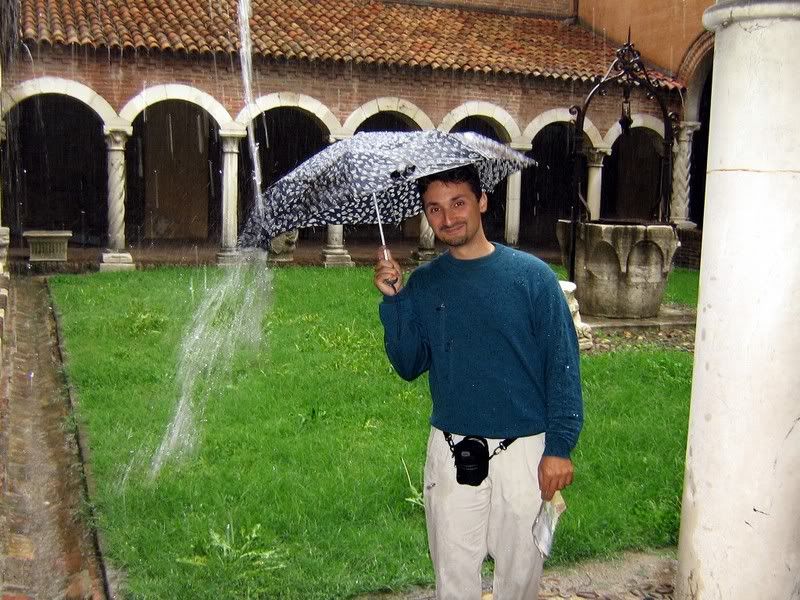
Sunday the bad weather reached its highest level of the whole week. We woke up with an intense rain that accompanied us all along while we were preparing our backpacks (which we left in our room during the day), paused briefly during the search for the breakfast and then came back in full force during the whole day.

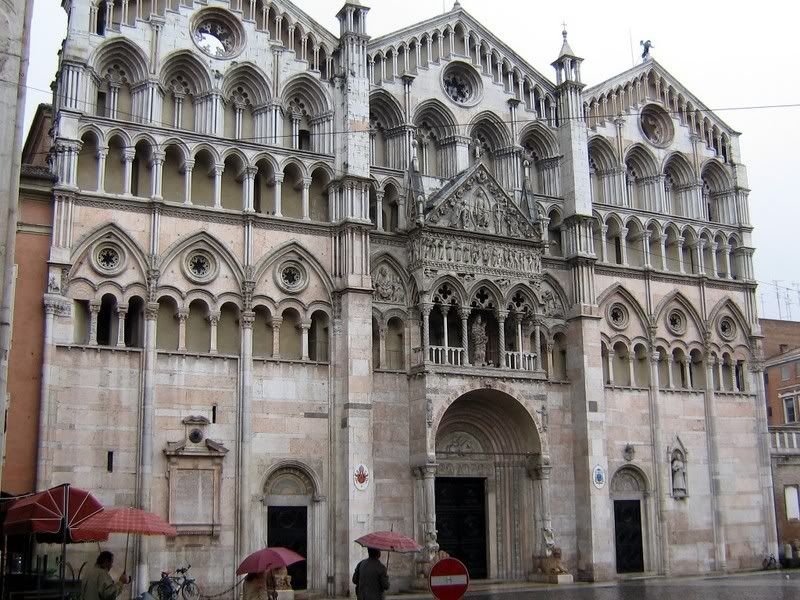
Maybe it was the 2 days of rain, maybe the tiredness of the whole week, fact is that the morning of Ferrara was characterized by a major disagreement between Susanne and me. It happened that, as we got out of the hotel, we bumped, right in front of the cathedral (right), in music and a crowd cheering. As it turned out, was the Bersaglieri's (the second oldest corp of the italian army) day. Now, it happens that I tend to be slightly nationalistic (in the "I love my country" not aggressive form) with, among others, a penchant for the italian military elite forces and navy. Susanne, on the other hand, was raised in the classic "any form of nationalism is bad, the armed forces are bad and everything related to them is bad as well" german way, which is even understandable, but still...

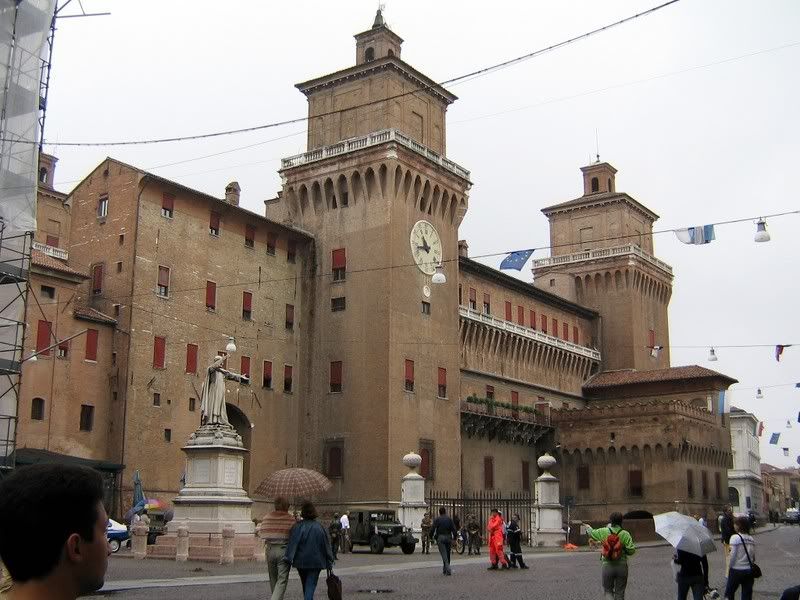
At some point, Susann'e had a line sounding like "Those people cheering and applauding for something there's nothing to be proud of get on my nerves" which I took as a personal attack (which it was, even if just indirectly and it was not meant to, obviously). That brought an exchange of definitely unpleasant comments on both sides which had as consequence a bad feeling cloud adding to the already thick rain ones and hovering over us for the whole breakfast, our visit to the cathedral and the beginning of the visit to the castle (left), until a strange kind of "peace-talks" along the various rooms of the castle's first floor brought an end to the incident.

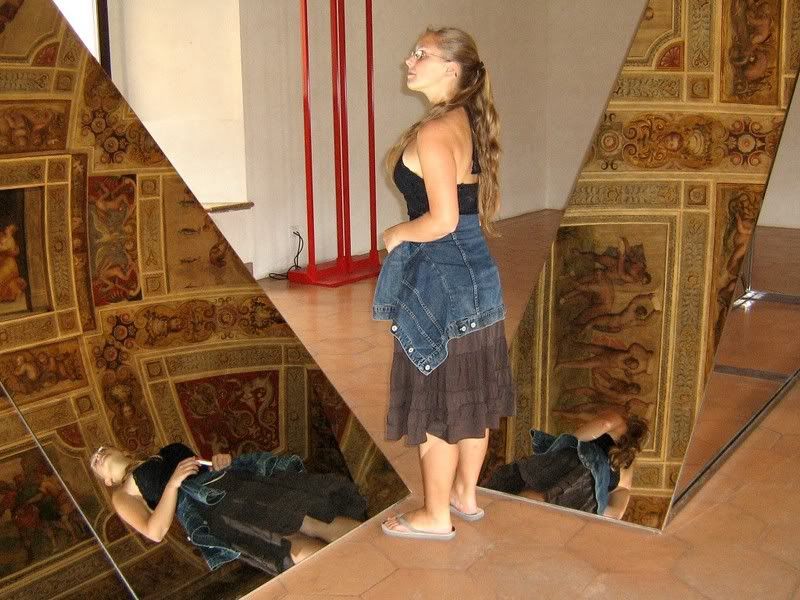
Anyway, Ferrara's cathedral was briefly (there was a service going on) visited and I must admit I remembered it differently and more magnificent. Then we moved to the castle where I had never been and that has been arranged in a way to explain, along the various room, the history of the city, of the Este family, rulers of Ferrara during the end middle age and the whole renaissance and of the life of the period. A very nicely done work, I think. Also interesting was the use of mirrors in the main rooms allowing the visitors to admire the roofs' frescoes without having to stress their necks (not to mention, at some point they multiplied my girlfriend for three...). We were also sort of fascinated by the castle's dungeons (where, among others, a member of the Este family had been kept for 52 years straight).

As we went out, the rain had turned in a real tropical storm. We simply ran to the closer arcade that happened to host a MacDonald and there we had lunch. At the end of it, Susanne had the unwise idea of picking up a leaflet which listed the calories of the various MacDonald's entries. It turned out, I had consumed over 1600 calories in a single meal and Susanne's "salad and nothing" else had already a worrying amount of them as well. The ending line is: NEVER get a MacTasty menu, ever.

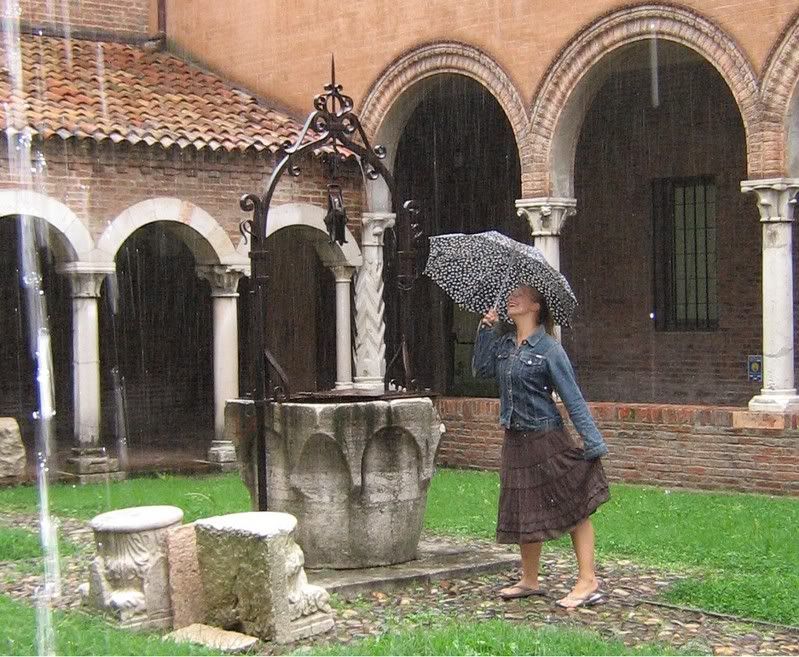
So bad was the rain that I called home for them to get on the net and looked for an alternative train for us to return home earlier, but that turned out to be impossible. As we got out of the Mac, we tried to wandered around a bit walking under the arcades, but eventually we were so soaking wet that it made no difference and we started playing around with the water. As the hour came, we got back to the hotel, took our stuff and marched to the station, again under the rain. It turned out, the large backpack I was carrying wasn't so much waterproof and the travelling guides got wet and partially ruined.

Sunday 13th - Rome - The end of the journey

The travel back home was, luckily unadventurous and the arrival more or less on time. At the Termini station we even found my brother waiting for us which, considering the general exhaustion level we had reached, was indeed a very good thing. As we got home (and found my whole family there) we didn't even try to unpack before crashing to bed. The journey was over.


Friday, September 29, 2006

Travel Chronicles VII - Winter - From Ferrara to Ravenna and back

Saturday 12th - Ferrara - Italian drivers

Saturday we got up relatively late for our standards, finding an ever greyer sky than the day before and a slightly chilly air. We got out of the bed and headed out looking for breakfast that, I had found out the evening before, wasn't provided by the hotel. We fell back on the typical italian breakfast (cappuccino and croissant or equivalent) which, I'm afraid, left Susanne deeply unsatisfied.

We made it to the station at a much quicker pace than the evening before and found out an unpleasant surprise. Despite the fact of having purchased all the train tickets in advance in a travel agency, we discovered that the Ferrara-Ravenna rail line was out of business due of maintenance works for the whole month of August and until Sunday 13th september, the day after (our usual luck). As an alternative means of transportation, a couch, stopping in every little station, so to make a 50 minutes train trip a 2 hours drive.

Having no other choice, we boarded the couch and we unwisely choose the very first places, right behind the driver, so that we could be overly pleased to see the driver answering his mobile phone and driving with a single hand for 4 times, one of which while passing a dangerous crossing and another while making a hard turn. As I disembarked I was really tempted to go to the police.


Saturday 12th - Ravenna - Rain and the miraculous drive back

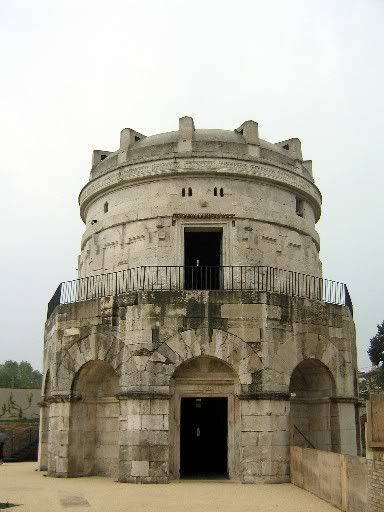
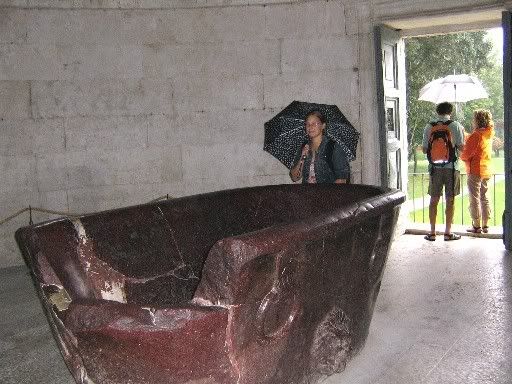
As we disembarked in front of Ravenna's station rain started to fall thickly on us. After a moment of loss of directions (it happened surprisingly often to me during the week, which is somewhat surprising to me as I had always had a very good orientation sense), we headed towards the north-east part of the city, towards one of the most peculiar monuments of Ravenna, Theodoric's Mausoleum, the first of eight locations in Ravenna (probably a record for such a small city) in the UNESCO's world heritage list. What I didn't know before this visit and left me with quite some awe is that the roof of the mausoleum is made with a single stone of 10 meters of diameter weighting 300 tons and I still wonder how did they raised there (it seems that as they dropped it, its weight created a fissure in the rock). The body of the barbaric king did lay in a porphyry (regarded by romans as the "imperial" stone) tub, originally from some roman baths, which is still there today.

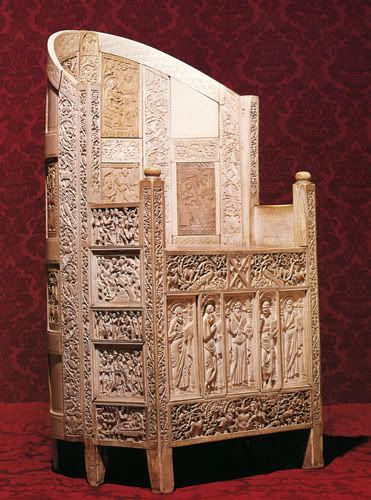
Once finished there, we started walking towards the city and it's many byzantine, mosaic ornate, churches, but a particularly intense rain forced us to seek refuge under the remains of the city's castle, Rocca Brancaleone. As we could move again, we headed towards the San Vitale / Galla Placidia's mausoleum complex, famous for its magnificent mosaics showing Emperor Justinian and his wife Theodora. Still under heavy rain, we moved out and entered the first place providing food and there, as a miracle, the rain stopped to start again as soon as we moved towards the Neonian Baptistery and the, unimpressive, city Dome. Moving to the archbishop's palace, we found out that the famous Archiepiscopal Chapel was closed, but the
museum, on the other hand, was open and presented two unusual objects, the "Ivory seat", the bishop's throne all covered with ivory bas-reliefs, and an universal Easter calendar on stone.

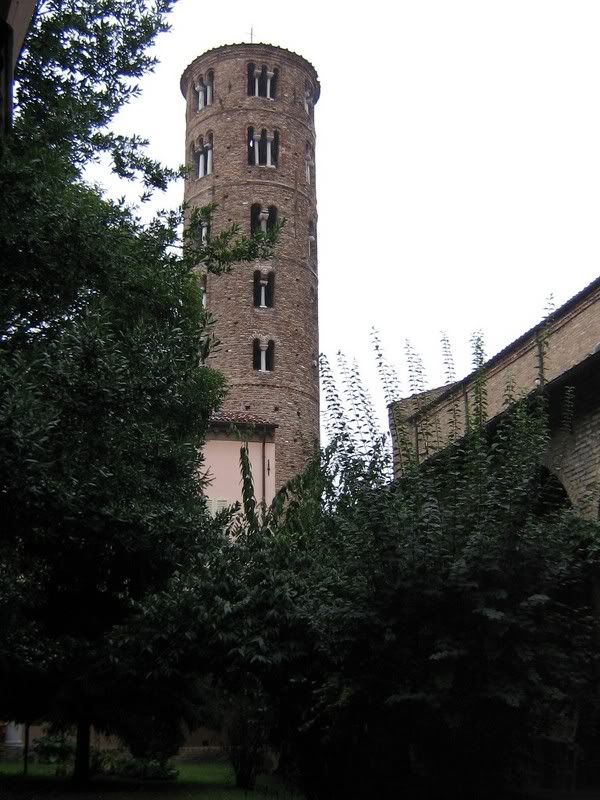
As we moved out from the Dome the rain, if possible, increased even more and was somewhat hard to reach the next objective, the basilica of Saint Apollinare Nuovo, famous for its "political" mosaics and its tower bell (on the right, taken from the church's cloister).

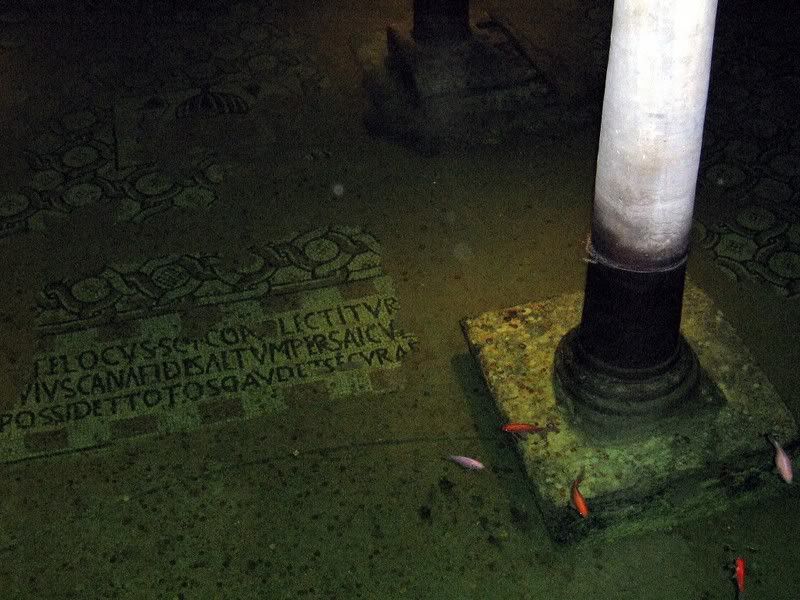
Moving out of Saint Apollinare I tried to locate the burial place of Dante, which, unknown by many, is in Ravenna, near the church of San Francesco. The monument itself is nothing impressing, but the story of the relics of the italian most important poet is novel material with attempts by Florence (from where he was exiled and could never return) of taking it back, the bones being hidden, lost, recovered, hidden and lost again and finally resting in peace. The church itself is interesting, with its crypt flooded by water in which fishes happily swimming among columns and mosaics (left).

After Dante's burial place, the rain won and we gave up the idea of reaching San Apollinare in Classe. We moved towards the train station and sat at a bar for a warm cappuccino to recover our strengths or at least a bit of warmth. Then, an inspiration fell on me and I decided I had to play the lotto with Susanne, so we looked for a bar where they could take the bet (for the chronicles, we got 2 numbers out of 6).

And here starts the odyssey of our return. We reached the train station under heavy rain (as indicated by Susanne in the picture) and there two coaches were waiting, one stopping at every station and another that would had stopped only in the major ones. We boarded, obviously, the second and in the whole 62 places bus there were only 3 people, Susanne, me and another girl. The driver was a new one, but with the same habit of the old one, as he started speaking on his mobile while driving but, surprisingly, at some point he asked us if we did mind switching over a minivan. We agreed, even because it would had been faster, and at the next station our coach drive became a taxi drive as the other girl disembarked. A nightmarish taxi drive, as the driver sped, surpassed on a straight line street which was far from being in good shape and without much light at all. Eventually, Susanne and me were holding our hands tight, sending each other looks of anxiety and wondering if we would had made it alive. We obviously did and the driver was even nice enough to deliver us at the castle rather than at the station, which spared us 2 kms of walks under what had became a real storm.

Saturday 12th - Ferrara - The quiet after the storm

Even if dropped at a few hundreds meters from the hotel, we arrived totally drenched. Quite obviously, by the time we were ready to go out again to have dinner, the rain was over. Yet, we were exhausted and we headed straight to the restaurant right under the hotel, called "La gatta sul tetto". I had suspects about the place (bad experiences taught me never to trust a restaurant without a menu where checking the prices), but eventually I was pleasantly surprised as we had the best dinner of the whole travel and the prices were reasonable. Too tired to explore Ferrara at night, we called it a night. A night without toothpaste, obviously.

Thursday, September 28, 2006

Travel Chronicles VI - Autumn - From Venice to Ferrara

Friday 11th - Venice - Up and Down, Right and Left

Friday night we were awoke by the extremely heavy rain that was falling and that worries us a bit for hat would had been our second and last day in Venice. As the morning came, for the first time in my life, I ad breakfast in a bedroom and I must say, it was nice. The rain had stopped by then, but it started exactly as, fully loaded, we walked out to the bed 6 breakfast to reach the station and leave the main backpack there for the day. We waited for the worse to pass and then, still under the rain, we marched back to the station.

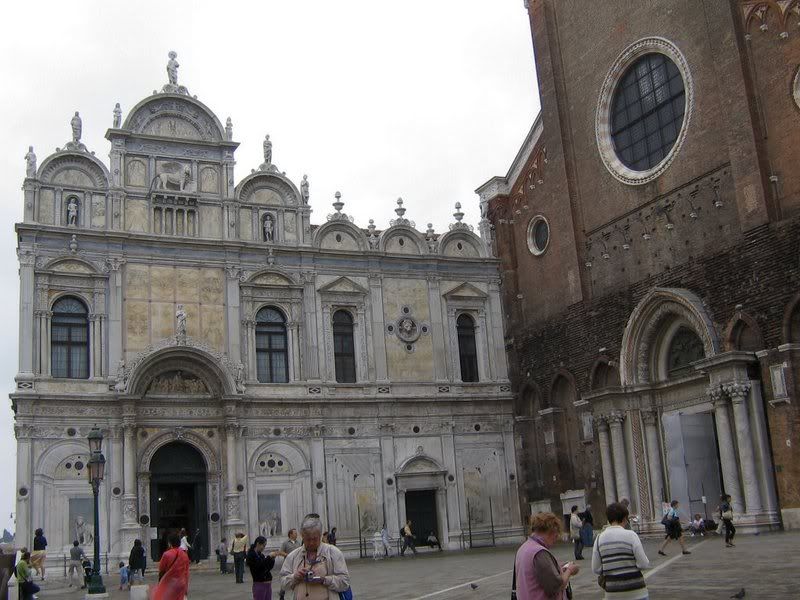
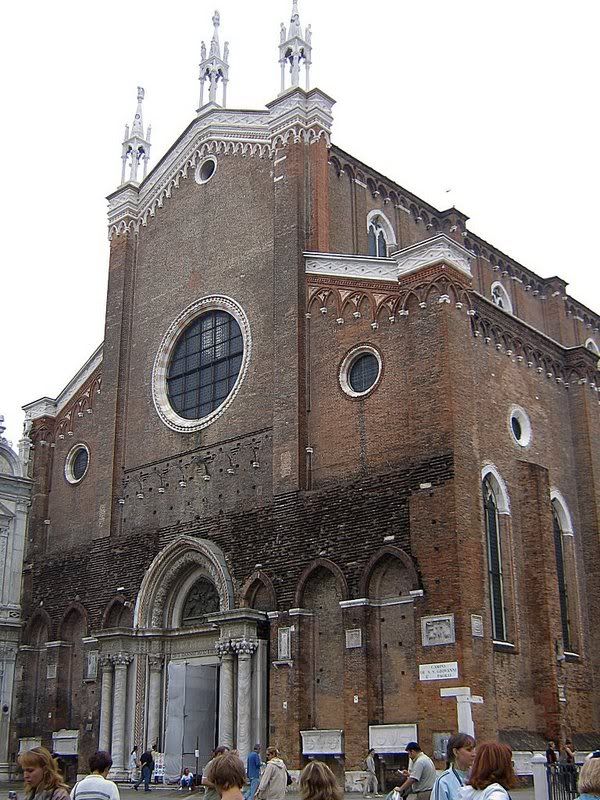
From the Station, we marched to San Giovanni and Paolo's church, known in Venice as "San Zanipolo", the second most important church of the city and traditional burial place of the venedian doges and most important captains (for instance, the Venedian admiral Sebastiano Venier, leader the fleet at Lepanto is buried here, together with the last defender of Cyprus, Marcantonio Bragadin, eventually flayed alive by the Turks). We visited the basilica thoroughly and then moved towards Rialto.

Once arrived at the bridge, we had to face a problem which presented itself greater than expected. we knew the ferries would had been on strike, but I had read, and consequently erroneously believed, that a few runs would had been there anyway. I was wrong. As we found out, not a single ferry was running besides the ones connecting the main islands with the minor ones. So it was that we haded towards the "Accademia bridge" and from there to the church of Santa Maria della Salute. And we went right, and we went left, and up the bridges and down the bridges, occasionally got on the wrong track and walked back, and the few hundreds of meters that by air separated us from our arrival point became kilometers that we covered in over a hour, only to find the church closed for lunch.

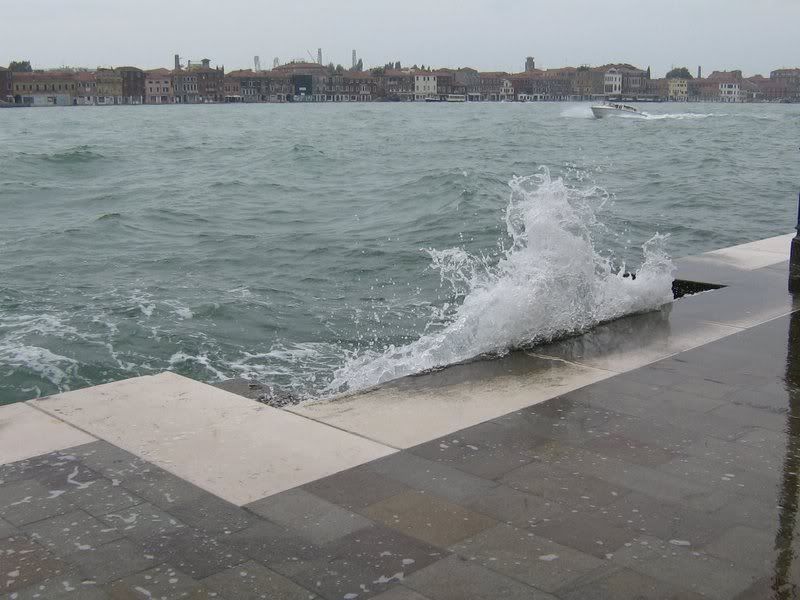
We gave it up and took a long walk back passing along the "zattere", the northern side of Venice, and noticed how much high was the water, so much to occasionally invade the platform (indeed, the day after the water would had raised another 10 centimeters and flooded the city for the first time this year). We looked for something to eat and then we went to visit the "Ca Rezzonico" museum, also known as the museum of the '700 where, among many interesting things giving an idea of how a venedian noble mansion would had looked during the XVIII century, are hosted some wonderful frescoes by Tiepolo (which is one of the painters I like the most together with my father and in fact at the end I got him a book about these frescoes).

As we headed out from the long visit t the museum, our time in Venice was already close to the end. We took the long walk to the station again and then decided to eat something, first at a kind of self-service restaurant we had discovered the day before (called "BreaK") serving big mixed salad and where I was tempted to leave without paying after that no one present himself at the cash-machine for a very long while (No, I did pay in the end) and then at a macdonald which the signs called to be at "8 minutes walk" and that revealed itself to be at twice as much distance. As we headed back to the station and boarded our train to Ferrara, a shy sun poked out of the clouds. I think I heard him laughing.


Friday 11th - Ferrara - Spiders! Spiders everywhere!

By the time we arrived in Ferrara, we were pretty fatigued and having to walk from the train station to the cathedral (the hotel I got in Ferrara was right behind that) with the main backpack on my shoulders finished the work, totally exhausting me. The hotel itself was great, if not for a little problem.

While I was dealing with check-in, Susanne appeared with a strange face. Turned out, over the wall of the room there was a spider and a pretty big one at that, to be honest. Now Susanne is scared as hell by spiders and I jumped at the opportunity of filling the role of my dreams, the white knight in shining armor running to help the damsel in distress. Funnily enough the woman in charge of the place for the night gave me a kind of sweep ending in a spear-like broom. But it happened that the spider survived a perfectly aimed and pretty strong hit, falling down and hiding, and in the meanwhile another one, smaller but not less menacing, appeared from behind the bed. At that point, we decided to leave the ground to them and accepted the other room we were offered. And there we finally collapsed, the thought of the toothpaste only briefly passing through my mind.

Wednesday, September 27, 2006

Travel Chronicles V - Autumn - From Montagnana to Venice

Thursday 11th - Montagnana - "Oh, noooooooo"

When the alarm clock rung (or sung, whatever) at 5:45 am, the second thing I heard in the total silence of montagnana was a painful "oh, nooooooo" coming from under the blankets on my right. Truth to be said, we had ended up in bed after midnight to prepare everything and the few hours of sleep hadn't been enough at all, but the thought that in just a few hours we would had been in Venice, together with an abundant breakfast, quickly rekindled our strengths.

Montagnana was almost eerie when we got out and soon I realized why: the sky had totally changed and was a dark grey. Our luck with weather, that until the day before had been a full summer, had gone and exactly in the moment we would had liked it the least. In any case, by 7.15 we were on the train in route to Venice, with a brief stop in Padua to switch and by 9.30, in perfect time, we arrived to Venice.


Thursday 11th - Venice - Lost in the maze

Venice's train station in probably the only one in the world surrounded by the water. As soon as you walk out of it, you already are faced by one of the major venetian channels, crossed by a a somewhat steep bridge which we crossed readily. To be noted, I was loaded with the large backpack which was hosting most of our belongings and that was probably weighting a good 20 kgs. Passed the bridge, we entered the intricate maze-like streets of Venice, sometimes so narrow to not allow two people to walk side by side, and sometimes not allowing a single person to pass if not turned on its side.

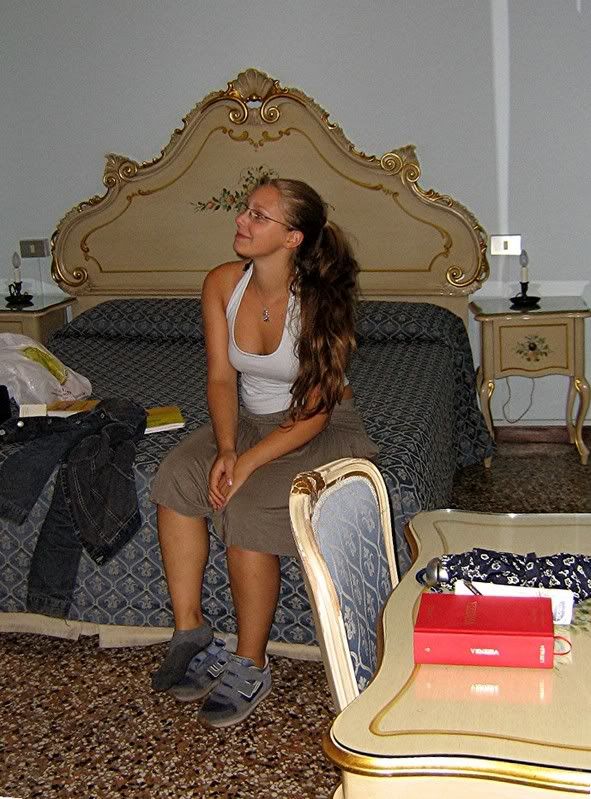
Soon, too soon as it turned out, we reached the B&B that where we would had stayed the night and where we counted to leave our stuff before proceeding in the exploration. We had to wait a while as the previous guests checked out and the room was put in order, but we were then positively impressed by the room, with XVIII century venetian-style furnitures.

Unfortunately, as we were waiting for our room, an unwelcomed guest showed up that would had been with us for the days to come: the rain. To be honest, we were lucky in the misfortune in Venice. The first day it made just a few quick appearances to remind us of her during the day, but then, despite a grey sky (which gives Venice a given atmosphere I do not really dislike), it mostly spared us when we were outdoor, just as much as the second day when it made a much stronger appearance, but again limited to about a hour (just the time needed to go from the apartment to the station, obviously).

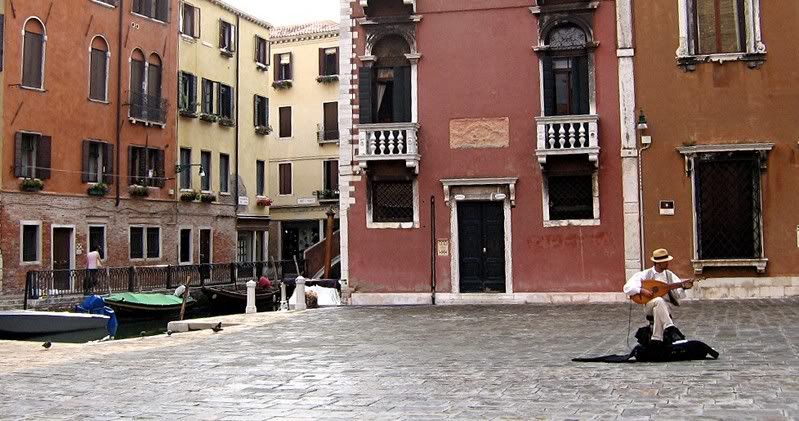
Taken possession of the room, we headed out and walked to the "Frari", one of the main churches of Venice, not too far from our B&B (Which I chose very close to a "vaporetto", the Venice ferries that take the place of buses, and to the Rialto bridge). In front of it, and not unlike Padua, we were welcomed by music in the shape of a lone player of lute.

Leaving the description of the church itself to more appropriate venues, I shall just comment on one thing peculiar of Venice and that I'd like to be introduced in Rome: you do pay a small fee to visit churches and other historical places, but not if you are a resident of the city. I didn't mind paying 2 euros to visit this and other churches in Venice (as I didn't mind paying such small fees in other churches in other cities), but I think it's just proper that a citizen of a city to be allowed to visit his own places without having to pay. Mutatis mutandis, I'd like to be able to enter the Colosseum for free, as I used to when I was a kid: it's my city, i have the right to live it fully, I do pay taxes to it, after all!

Leaving the church, we headed to San Marco passing over the Rialto bridge. There, we were part of a funny incident. As we were at the very top of the bridge and looking at the "Canal Grande", I noticed what I classified as the largest woman I had ever seen next to me, giving me her back and saying something really loud in german. She was indeed huge, with shoulders of a wrestler. Then she turned and I said to myself "ok, correction here, it's the largest transvestite ever" while at the same time a wide smile appeared over Susanne's face. As the woman/man kept acting in a weird way I issued another correction "ok, that is the largest german crazy transvestite ever", but as a TV camera appeared Susanne finally explained to me I was facing a famous german comedian, Hans-Werner Olm in her "Luise" character.

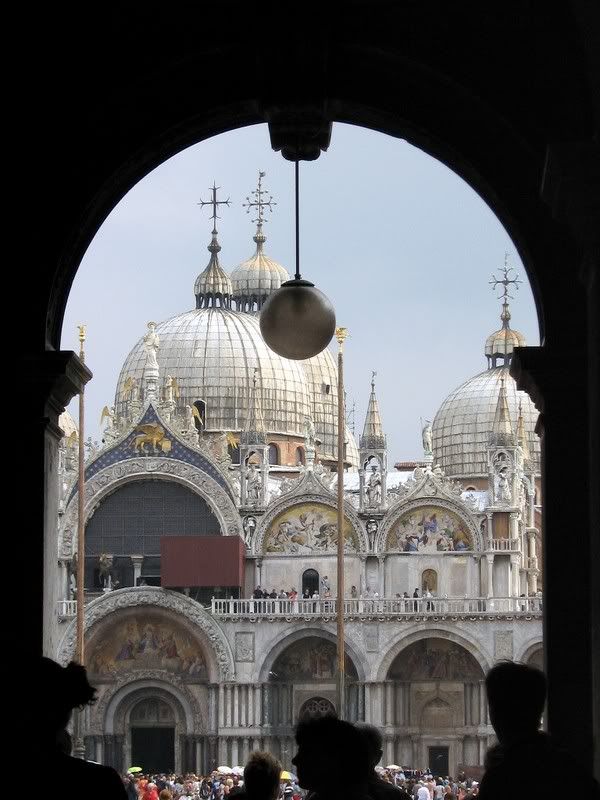
Crossed Rialto bridge, we walked in the maze of narrows streets until I finally had to admit my orientation sense was badly failing me and, not without shame, I passed the lead to Susanne who, honestly, seemed to feel more at home in such a situation and not much later finally took us to Piazza San Marco, where I was immediately nauseated by the stink of thousands of pigeons people think funny to feed and have all over them (literally). We headed for the cathedral (after having left our small backpack at a near church turned into a wardrobe) and thoroughly visited that, included the presbiterium with its majestic "Pala d'oro", occasionally annoyed by the loud voice of an american guide leading a group of only slightly noisy people (in a church where, in theory, you should keep silence all the time).

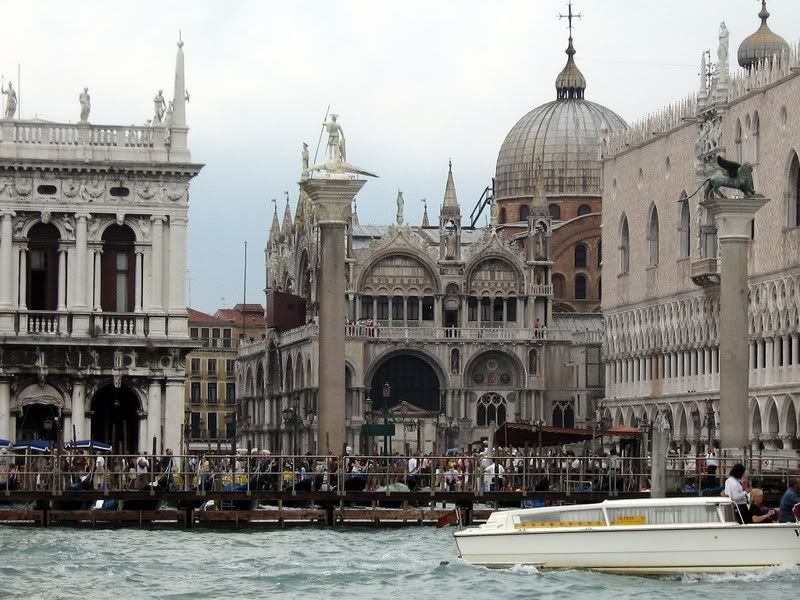
Having left the cathedral, we went in search for the tourist information office to buy a daily ticket for the ferries and an integrated museum ticket. There, we got to know that, being the lucky ones we are, the ferries would had been in strike the whole day after. once we got the ticket, we headed and visited the truly magnificent Palazzo Ducale, prisons included (note for erudite italians: we crossed a group of people saying things like "Ah, is it the way DOWN for the Piombi prisons" or "Ah, such prisons are so bad, no wonder Silvio Pellico wrote "Le mie prigioni" here".. no comment). Left the palace, a good 3 hours later, more or less starved, I paid the first of several visits to a MacDonald (which, by hindsight, was a wise choice as future experiences would had led me to create a whole theory about eating in given cities) and then, in order to rest and at the same time not wasting any time of the few precious hours we had in Venice, we took the ferry that runs all along the Canal Grande and we were so lucky to get immediately the two places right at the tip of the boat, enjoying a great and unimpeded view for the whole cruise.

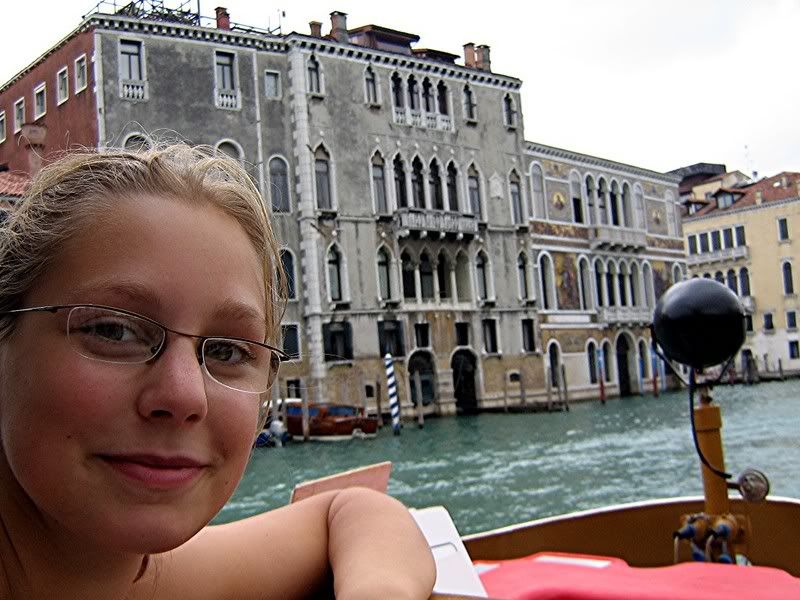
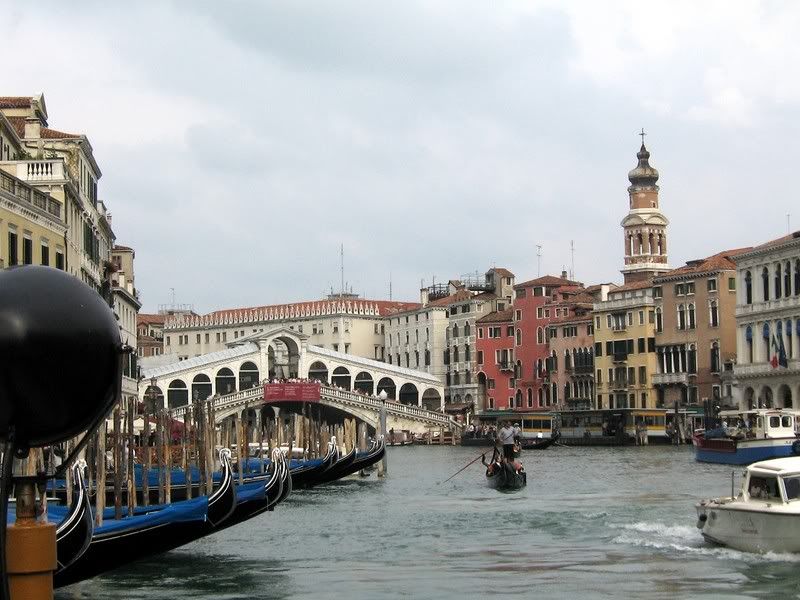
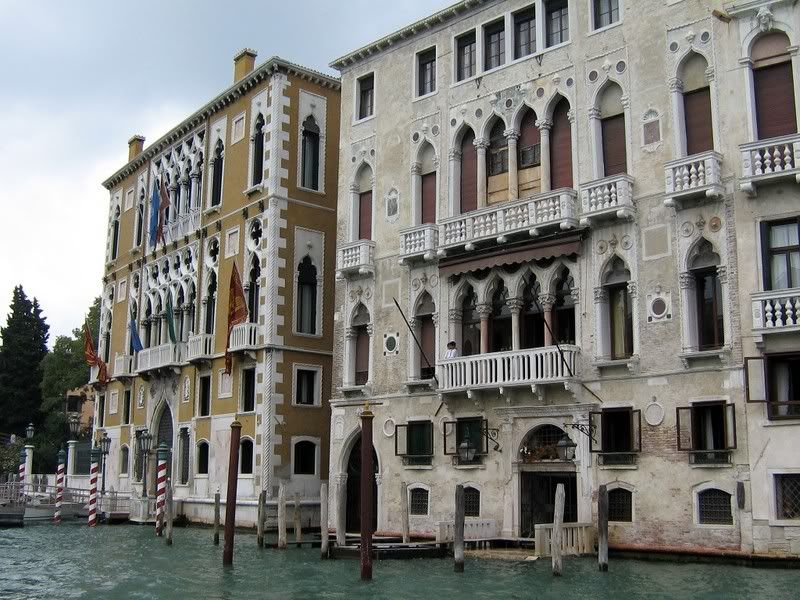
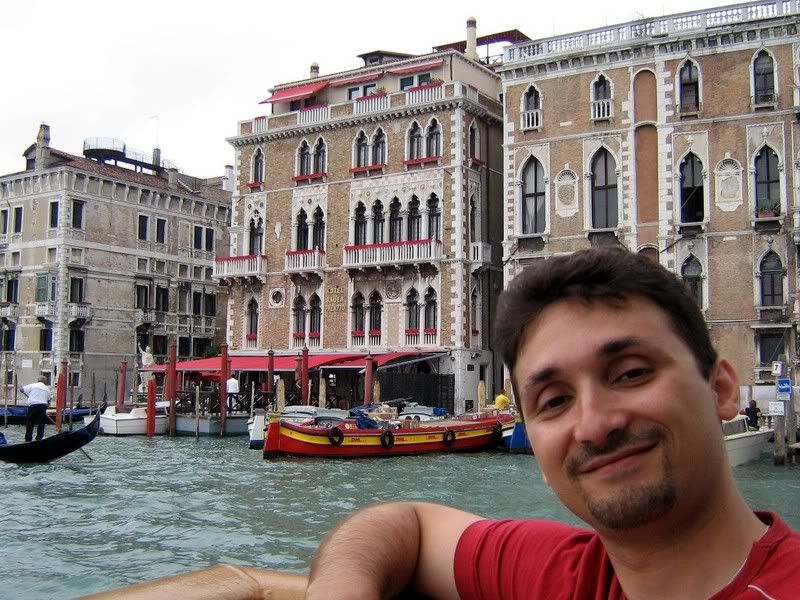
It was, as I did remember it from my first visit 15 years before, a breathtaking experience: the palaces and their peculiar style, S. Maria della Salute's church, the gondolas, the flags, the wooden taxi-boats, Rialto's bridge... everything seemed just perfect to me and even the cloudy sky, in my opinion, added to it, making it melancholic but not gloomy. And Susanne's expression of awe and joy just made it even better, I must say.

Disembarked once again at the train station, we took another ferry, this time towards Murano, where we would had liked to see the glass-blowing artisans. We got an interesting cruise again, seeing the much less touristic and therefore usually neglected northern side of the city from the sea and we arrived on the island in a sudden, violent but luckily quick shower of rain. Unfortunately, we discovered that the glass-blowing activity, especially after the summer, goes on only during the morning. I then took Susanne to visit the little but wonderful church of San Donato, with its mosaics and external abside, and then we spent a bit of time looking for something for my mother (I eventually took her a necklace made of tiny glasses of different colors).
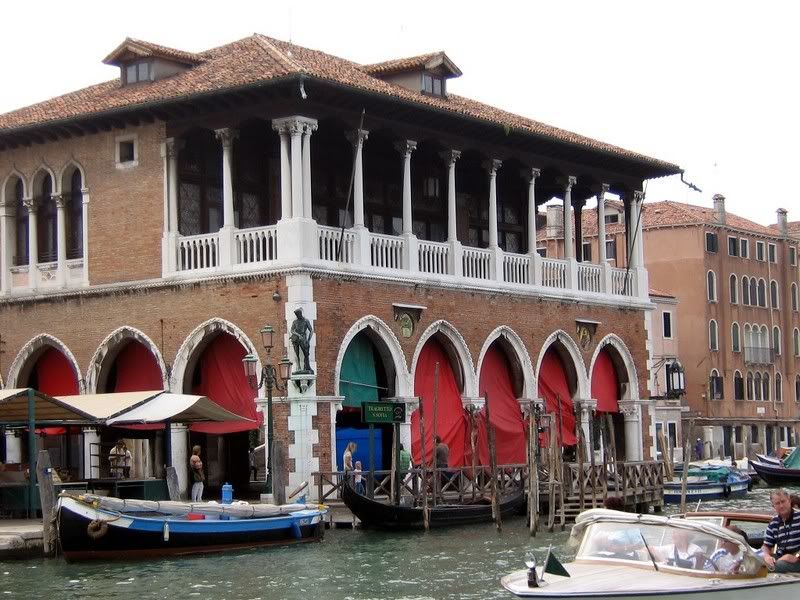
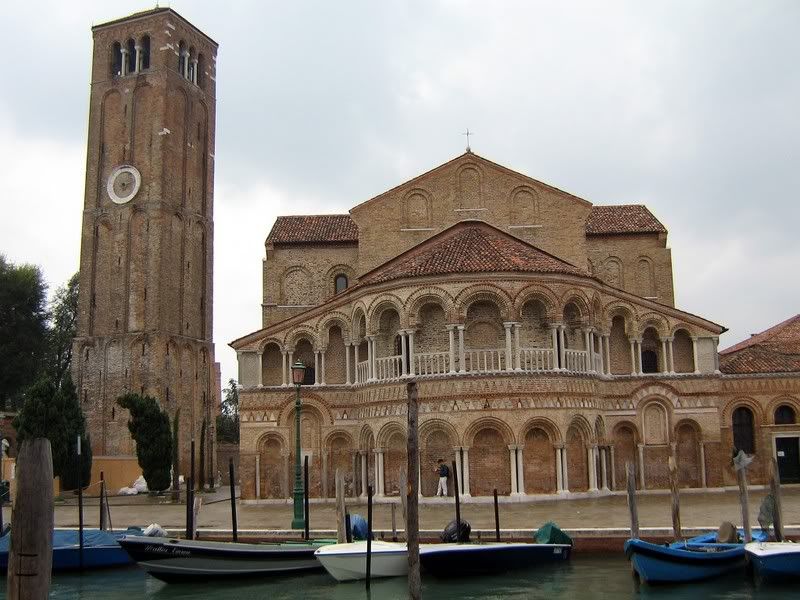
We got back from Murano, again under rain, and we headed home to dry ourselves as, amazingly for such an organized person as she is, Susanne's shoes weren't waterproof and got totally soaked at the first drops of rain (which proved to be a problem in the next days and was solved in Venice with a hair-drier...) and prepare for dinner. And here I elaborated a theory: in places like Venice (and London) you better go at a MacDonald unless you are up for leaving 50 euros per person at a restaurant. In fact, we did indeed go to a restaurant where I had the displeasure of eating one of the worst pizzas I ever tried and Susanne the strangest mixed salad I had ever seen... everything for the price of an averagely abundant meal in a nice restaurant in Rome, which is not famous for being such a cheap city itself. After that, another ferry cruise along the Canal Grande at night (a bit sad, truly) and to the Arsenal. After a long, aimless, walk around the area we decided to get back home and call an end to our first day in Venice.